Who is Michael Vaccaro?
Counsellor, Coach & Founder of New Way of Being
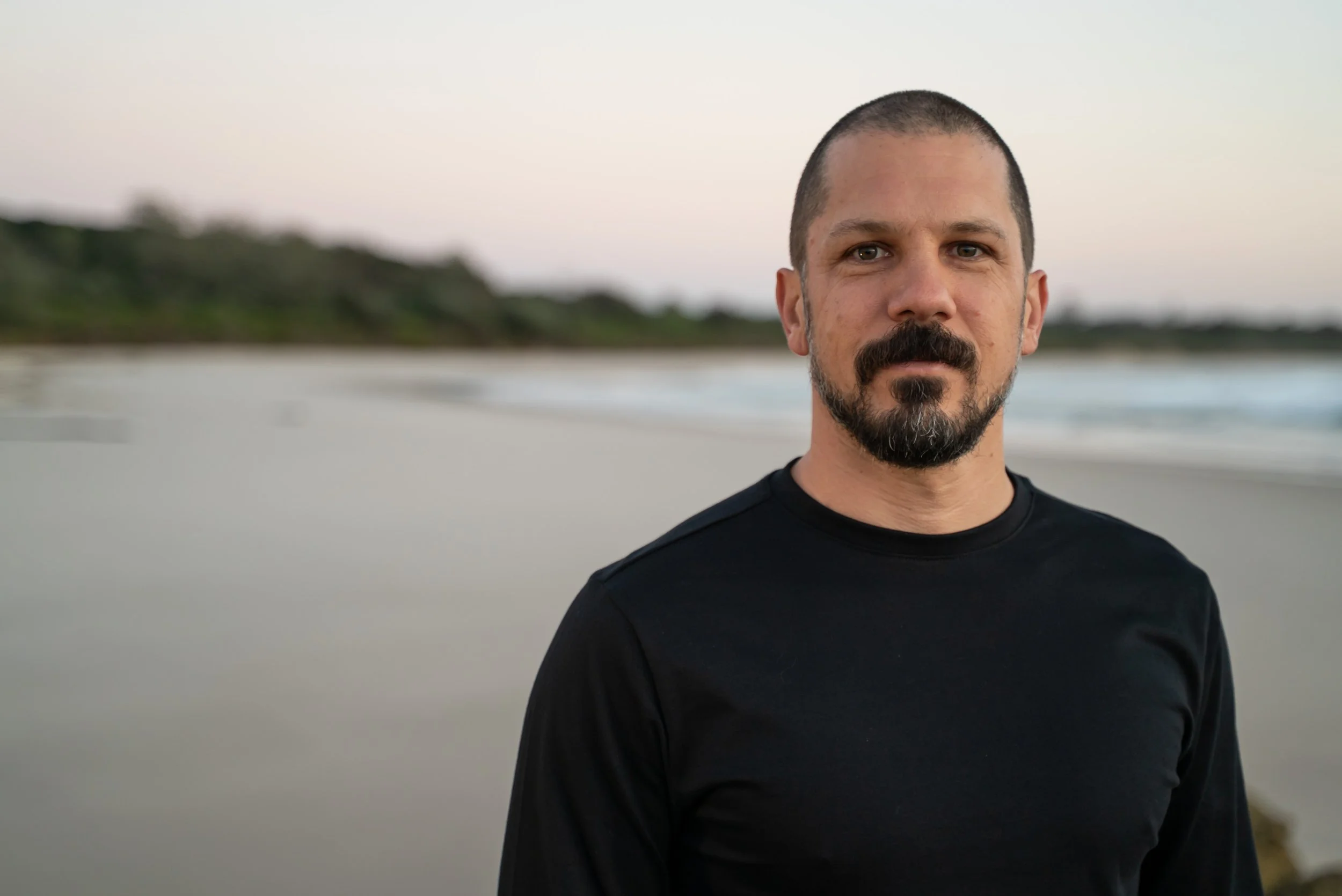
Hi, I’m Michael Vaccaro, founder of New Way of Being, The Powerful Man Program and The Conscious Couples Program.
I’m a clinical counsellor, coach, facilitator and teacher based in the Northern Rivers of NSW, working across men’s work, women’s work, couples work, professional and leadership development, and facilitator development.
My work brings together counselling, mindfulness, relationship therapy, men’s work, leadership development, somatic awareness, self-inquiry and more than two decades of meditation and spiritual practice.
For me underneath all of those approaches is one central inquiry:
How do we free ourselves of unnecessary suffering and become more deeply authentic, connected and live, love and lead from what is actually true?
Can we be Happy?
How I Came to This Work
My journey to hear has actually been quite messy, meandering and rife with plenty of strife.
From a young age I was drawn to questions about God, death, suffering, meaning and purpose.
By my teenage years, that sensitivity had become intertwined with anxiety, depression, insomnia, addiction and a strong desire to escape what I was experiencing internally.
One night, unable to sleep, I found a simple breathing meditation in a book and decided to try it.
Within minutes my body settled and I fell asleep.
It was a small moment, but it changed the direction of my life.
For the first time I realised that I could develop a different relationship with my inner world.
I didn’t always have to escape what I was experiencing.
I could become present to it.
That discovery began what has now become more than twenty years of meditation, self-inquiry, psychology, spirituality and human development.
And in many ways, it also contained the seed of what I now describe as the Four Stages of Change:
Problem → Presence → Purpose → Power.
We begin caught inside a problem.
The problem brings attention acutely into what is happening right now.
Our perspective is transformed by the challenge into something Truer and more Authentic..
And from that place, we regain the capacity to respond with intention.
You will find all of the ways I communicate Transformation comes back to this concept.
From Insight to Transformation
Over the years I travelled through South East Asia, India and Nepal, lived and practised in ashrams, sat meditation retreats, explored the Buddhism, Yoga, Bhakti and Non-Dual traditions of the East, and immersed myself in different approaches to embodiment, men’s work and personal transformation.
In some ways I realised I was using these paths to escape, but life continued teaching me something important:
Insight & Skill is not the same thing as Transformation.
We can understand why we behave the way we do and still repeat the behaviour.
We can meditate and still avoid difficult conversations.
We can become emotionally expressive without knowing how to make wise decisions.
And we can know exactly what needs to change but never actually do it.
This gradually led me to recognise what I now call the Three Doors to Transformation:
Thinking. Feeling. Choosing.
Change requires insight into our own thinking.
We need to meet our internal experience intimately to enable the process of change.
And sometimes we already understand and feel deeply, and yet we fail to bring our realisation into our daily choices.
This is the method for processing what holds us back from real change.
My personal insight became integrated into how I work with people.
Learning How Change Actually Happens
That inquiry eventually led me more deeply into professional psychology and therapeutic practice.
I completed formal study in holistic human development, counselling and applied mindfulness, alongside ongoing training in couples therapy, trauma, attachment, somatic approaches, emotional regulation, Internal Family Systems and men’s mental health.
Over time I began facilitating meditation groups, men’s circles, retreats and workshops while working individually with clients and couples.
Through thousands of conversations, practices and experiments, another pattern became clear.
On a practical level I facilitate four tasks that facilitate sustainable change:
Internally
We need to understand what is happening, why and how to move through it.
As I mentioned above, we also need to process the emotional and embodied experience underneath it that we have been avoiding.
Externally
We need to practise the skill of processing, and what supports processing.
And eventually we need to experiment with bring our insights and our authentic selves inro our lives.
These became what I call the Four Foundations of Doing the Work:
Understanding → Processing → Practising → Experimenting.
Because ultimately the work has to leave the therapy room.
What Do I Actually Help People With?
Although my work spans different groups and contexts, I think of it as moving through Five Areas of Service:
Men’s Work · Women’s Work · Couples Work · Professional Work · Facilitator Work
The presenting issues may be very different, but the deeper human dynamics often overlap.
For example:
A man struggling to speak honestly in his marriage.
A woman who continually abandons her needs to preserve connection.
A couple trapped in criticism and withdrawal.
A leader avoiding a difficult conversation with their team.
A therapist or facilitator who understands their craft intellectually but struggles to remain grounded when intensity enters the room.
In each case, the deeper question is often:
What happens to me when there is friction between what I know is true and what feels acceptable, pleasent and safe?
How We Move in Relationship
Another important layer of understanding came through my work at Thrive Clinic in Mullumbimby, in the Byron Shire of Northern NSW.
One of my colleagues and supervisors, Joanne Walker, introduced me to a model of relational dynamics that brought together, in a surprisingly simple way, much of what I had previously encountered through the work of Brené Brown, Sue Johnson and Marshall Rosenberg.
The Map of Relational Possibilities, developed by Joanne Walker and Liz Coventry, helped me see a clear pattern beneath a great deal of psychological research, therapeutic theory and lived experience.
The way I now communicate this in my own work is through what I call the Three Core Wounds and the Five Directions of Relating.
The Three Core Wounds
Fear — “I am in danger.”
Shame — “I am bad.”
Powerlessness — “This is too much.”
There are many ways of understanding human vulnerability, and these three categories are not intended to explain every psychological experience.
I simply find them a useful way of recognising three fundamental forms of suffering that can become activated in us: a threat to safety, a threat to belonging and worth, and a threat to our sense of agency or capacity.
Much of what we do in relationship can then be understood as an attempt to manage these vulnerable states.
The Five Directions of Relating
When these wounds are activated unconsciously, we often move in one of three protective directions.
Shadow
The unconscious management of unconscious wounds.
Puff Up — Control
“I need to control this situation, person or experience in order to regain a sense of power.”
Shrink Down — Comply
“I need to accommodate the stronger force, suppress myself or maintain approval in order to preserve connection.”
Disengage — Avoid
“I need to withdraw, disconnect or escape in order to relieve the discomfort.”
These strategies are not necessarily signs that something is wrong with us.
They are often intelligent protective responses.
The difficulty comes when they become automatic, unconscious and rigid.
The alternative is not simply to “communicate better.”
It is to develop two additional directions of movement — toward intimacy with Self and intimacy with Other.
Conscious
The conscious reconnection with agency, awareness and love.
Connect with my inner world
Become present to my own feelings, needs, values, boundaries and choices.
Connect with your inner world
Become genuinely curious about your feelings, needs, experience and choices without abandoning my own.
This, for me, sits close to the heart of conscious relationship, emotional safety and genuine connection.
In many ways, the work I do could be described as supporting the movement from unconscious power dynamics toward conscious relating.
From Unconscious Protection to Conscious Relationship
What makes this model particularly useful to me is that these dynamics do not only happen between two people.
They can occur internally, relationally and collectively.
Internally
Something arises within me that threatens my sense of love, power or safety.
One part of me then attempts to control, comply with or avoid another part of myself.
I might suppress sadness because I believe it is weak.
Override exhaustion because I believe I should keep going.
Attack myself for feeling afraid.
Or disconnect from a need because acknowledging it feels too vulnerable.
The same relational pattern can exist inside one person.
Relationally
Something happens between two people that threatens love, agency or safety.
I then attempt to manage the discomfort by controlling you, complying with you or avoiding you.
Instead of remaining connected to both myself and you, one of us becomes the problem to be managed.
Conscious relating asks something different:
Can I remain connected to my own experience without abandoning yours?
And:
Can I remain open to your experience without abandoning myself?
Collectively
The same dynamics can also emerge between groups.
When a group experiences a threat to its identity, belonging, power or safety, people can collectively organise around attempts to control, submit to or distance themselves from another group.
The scale changes.
The underlying human dynamics can remain remarkably similar.
For me, this is why relational work reaches far beyond romantic relationships.
It touches families, workplaces, communities, leadership, culture and society.
Across all three levels, the movement I am interested in is fundamentally the same:
bringing conscious, compassionate awareness to the places where fear, shame and powerlessness have previously generated unconscious protection.
That awareness creates the possibility of choice.
And choice creates the possibility of a New Way of Being.
Masculinity, Femininity and Polarity
As a result of being raised in a culture facing the friction of an old paradigm of masculinity and a new pardim of femaninity, I personaly saought to redscover my rown elationship with my own masculoine and femanine sides.
I had found myself, frutrated with how my life was going and realising that I had completely ignored something glaringly obvious, I feared the masculine with myself and others.
This led me into questions of masculinity, femininity and polarity.
I don’t see masculine and feminine simply as fixed roles belonging to men and women.
I’m more interested in them as different capacities and movements available within human beings and relationships, direction and receptivity, structure and flow, stillness and movement, penetration and openness.
Problems emerge when these qualities become rigid, performative or collapsed.
The deeper inquiry is not:
“Am I masculine enough?”
or
“Am I feminine enough?”
but:
What qualities does this moment, relationship or stage of life require from me?
And am I unconsciously controling, complying or avoiding, the masculine or femanine movement within myself and others?
The Skills That Make Change Possible
I also came to see that beneath all of these models are practical capacities that can actually be developed.
Interestingly, I learned many of these skills before I understood the deeper transformational process I have described above.
For a long time, I thought the answer to my life was to become highly skilled — more disciplined, more aware, more regulated, more capable. In some ways, I wanted to become a master of myself.
Over time, however, I realised that skills alone are not transformation.
You can become very good at meditation and still avoid intimacy.
You can regulate your nervous system and still refuse to tell the truth.
You can understand your shadow and still keep repeating the same choices.
You can become disciplined, focused and psychologically sophisticated without necessarily becoming more aligned with who you are.
What I came to understand is that these skills are not the destination.
They are capacities that can significantly amplify the transformational process.
Over time I have come to identify what I call the Ten Skills That Amplify Lasting Change:
Present Moment Awareness, Self-Inquiry, Breath, Somatic Processing, Shadow Work, Authentic Self-Expression, Leadership Habits, Daily Action, Deep Rest and Mind Training.
Each of these skills, in its own right, can help a person navigate difficulty, increase resilience and improve the quality of their life.
But their deeper power comes from something more.
They increase our capacity to stay present when we are activated.
To see ourselves more clearly.
To process what has previously been avoided.
To express what is true.
To recover more quickly.
To act with greater intention.
And ultimately, to become more capable of creating a New Way of Being in our lives.
The skills are not the transformation.
They help us become capable of it.
From Inner Power to Outer Action
Another simple yet profound insight I came to realise is what I call the Four Foundations of Power:
Focus. Think. Say. Do.
Where do I place my attention?
How do I interpret what is happening?
What do I speak into the world?
And what do I actually do?
These four capacities profoundly shape the direction of a life.
We cannot control everything that happens to us.
But we can gradually become more conscious of where we place our attention, the thinking we reinforce, the language we use and the actions we repeatedly take.
That is a form of power available to almost all of us.
What Is New Way of Being?
New Way of Being is the name I have given to the broader body of work that has emerged from all of this.
It is my current answer to my enduring question:
How do deliver the best service I possibly can while remaining true to myself.
It is an evolving framework drawing from my personal life experience along with whhat I have learned from counselling, psychology, mindfulness, relationship work, somatic awareness, leadership development and contemplative practice.
At its centre is a simple premise:
We suffer when unconcious conditioning disconnects us from what is true, and transformation becomes possible as we learn to return.
For me, that is what a new way of being actually means.
Becoming increasingly capable of meeting life without continually abandoning ourselves.
If you’d like to know more about my personal story, professional qualifications, training, spiritual background and the experiences that have shaped this work, you can read my full About page here.
And if something in this resonates with where you are in your own life, relationship or work, you are welcome to get in touch.